
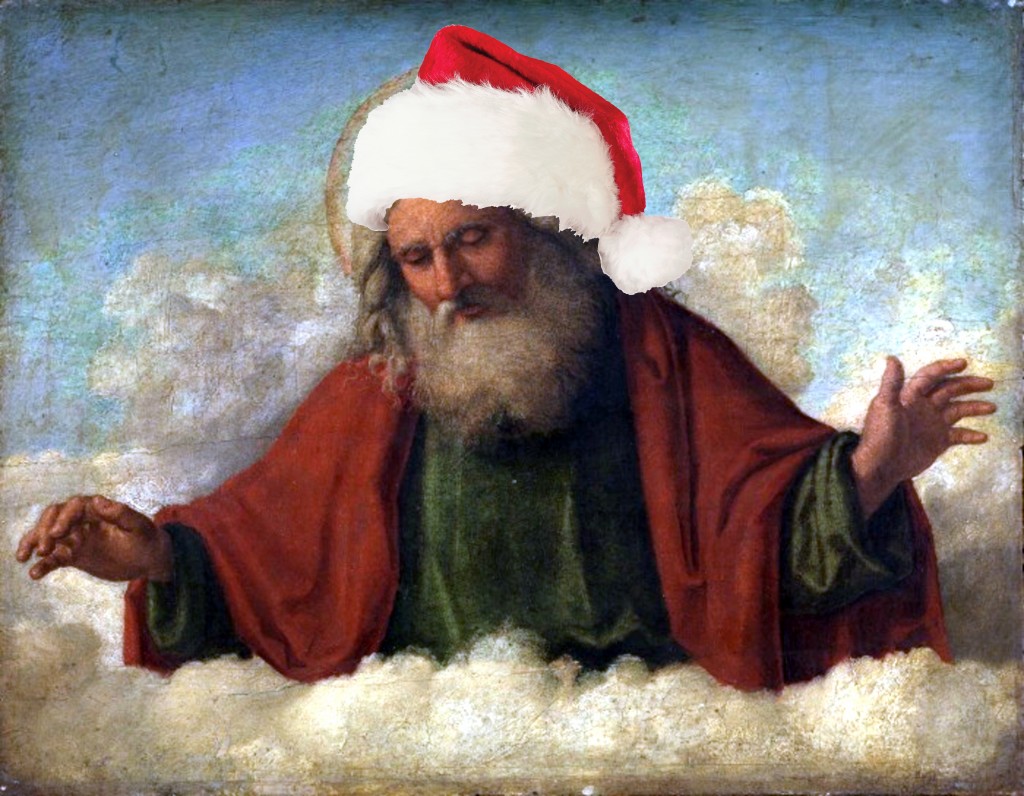
This year in particular I watched an array of Christmas movies with my family and noticed a peculiar similarity I had not paid attention to before, the link between the Christmas figure ‘Santa Claus’ and the Christian God. Maybe this is something other people have thought about before, but in my 24 years of life, growing up in a Christian household I had never seen a relation between the two. God was God, and the basis of the true meaning of Christmas (Well, Jesus). From a Sociological perspective I decided to investigate the link further to try to fully determine whether Santa is based on the Christian God.
A Father figure
Santa Claus was originally known as ‘Father Christmas’, dating back to St Nicholas who was Bishop of Myra, in Turkey in the 3rd century AD. He would travel in his red bishop’s robes and give gifts to the poor. My suspicion is that he was classified as a father figure because he was a provider.
The Christian God is believed by many to be the God of all three Abrahamic religions: Islam, Christianity and Judaism. But what separates the Christian God from the other two is the belief in the trinity (Father, Son and Holy Spirit). The relationships Christians have with the father is based on love and reflect that of an actual father: caring, patient and concerned his children. And the opposite holds true when a father is harsh, judgmental or absent.
An omnipotent being
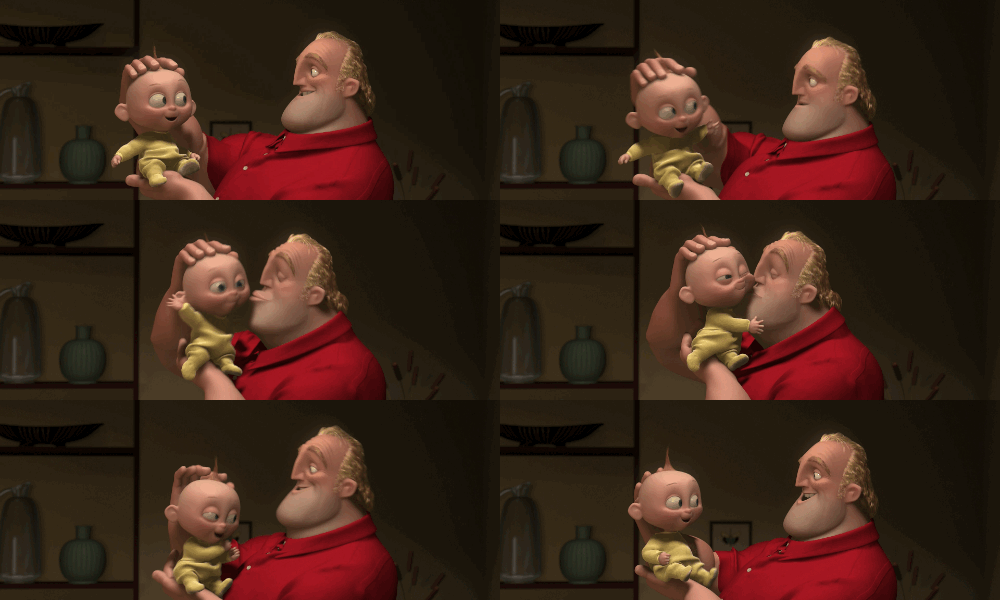
“He sees you when you’re sleeping. He knows when you’re awake. He knows if you’ve been bad or good so be good for goodness sake”
Psalm 147:5 – “Great is our Lord and mighty in power; his understanding has no limit.”

Omnipotency is the state of being all-powerful and knowing all things. The two revered being are expected to have our respect and they are meant to be morally and ethically sound. Our respect is expressed through our behaviour, belief, and tithes (cookie and milk for Santa, 10% of our salary for the church). Their main similarity in terms of power is their moral compass which is expressed through their list of who is ‘naughty or nice’ (Santa) and the ‘book of life’ (God). Both judge who is morally upright, and so who can receive the ultimate prize (Christmas presents and Heaven). The unmoral also have a fate, coal or hell. What is interesting hear is that both dooms are related to fire.
Elves vs Angels
Both are perceived to be helpers of their revered, all-knowing father to all. The way both help is by aiding the fathers in their delivery (gifts/messages) to human beings which represents just how real the fathers are. They both live close to the fathers, exist in large numbers and are not human, but not as powerful as the fathers.

Heaven vs North Pole
Both are thought to be an unknown place where both Fathers reside along with their helpers. Both are special places, not easily accessible to humans, and are both thought to be in the most northern of locations, placed above to symbolise their social and moral hierarchy with human beings. In some ways, this could also symbolise their physical hierarchy as both as viewed as having supernatural powers.

The question of belief
In both Christmas movies and the Bible, there is a constant running question around whether humans believe, and therefore respect the ultimate father. Those who do not believe are depicted as lost and ignorant, but depicted as logical to the rest of the world. In both, we (humans) are expected to believe without seeing, and in the rare moments when the Father reveal themselves to humans, the experience is beyond words, sticking with that person for the rest of their life, often altering their character and having an effect on those they interact with.
Children, therefore, are often favoured by both because they are the most likely to believe in the father, beyond the logic of the rest of the world who are out of believing because of the experiences that have happened during their lives.

So is Santa related to the Christian God? Most certainly. Why? I don’t know. The main theory I have seen suggests that God is Santa for children, so we believe in Santa as children to set a foundation for a greater belief as adults. I am not fully convinced by this, mainly because children in Christian countries tend to be taught as much about Santa as they are about the nativity story, sometime more so. So if you cared enough to read all the way up to this point and have an opinion on the matter then let me know!
@CillaHope_

 cillahope
If kids grow up believing in both but find out Santa isn’t real will their faith in God lack as well?
LikeLike
Well I’m in 2 minds about this because I think most Christian households would teach the nativity separately. So when they grow out of their belief in Santa they’d not associate this with Christianity.
LikeLike